
probably some of the real names of his compatriots he ratted on

Kaffe
- 34 Posts
- 655 Comments
Joined 4 years ago
Cake day: March 23rd, 2022
You are not logged in. If you use a Fediverse account that is able to follow users, you can follow this user.
tupac was a new afrikan communist
Judeo-Bolshevism and Islamo-Communism theories exist in the world at the same time, notably, no “Christian agenda” is antagonized like this.
 12·6 months ago
https://ssnp.online/مبادىء-الحزب-السوري-القومي-الاجتماعي/
https://ssnp.online/غاية-الحزب-وخطته/
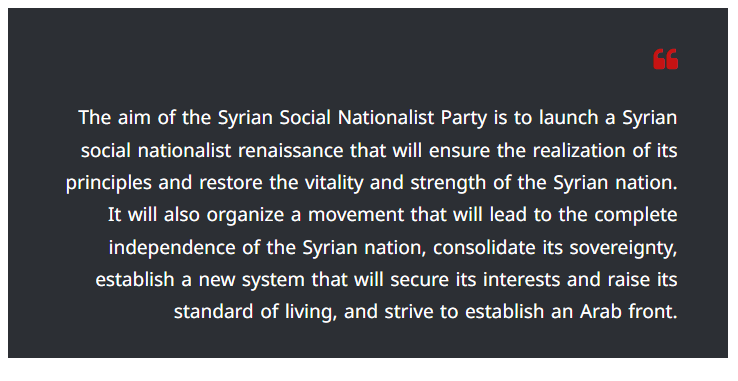
They have a website (link is in arabic it might look funny without rendering).
I don’t have a good collected source but some bullet points about them:
- The symbol is a merger of the Christian Cross and the Islamic Crescent, creating a pinwheel iconography, has nothing to do with the Nazis. The party is secular but these are the two largest faiths of Syria and Lebanon and wanted to bridge religious sectarianism and antagonize the partition of governments by faith.
- They were founded during French-ruled Lebanon I believe, one of their main points is that they want to bring Syria and Lebanon back together under one state. They were partitioned into Christian dominated and Muslim dominated states from effectively one historic country/region. The Social National party is secularist and views the division on religious grounds as unnecessary (for instance, the president of Lebanon must be a Christian). So this aspect, of bringing together a reunited Syria, is their main claim in Syrian (and Lebanese) politics.
- Not fascists, take no inspiration from fascist movements.
- Not Marxist, though some members are (but in practice most Marxists in the region were usually Communists or Baathists). They are mostly secular vaguely left liberals, some conservatives, kinda like a KMT-type coalition (which can obviously devolve into something nasty/reactionary).
- Their main main allies have historically been other Syrian Nationalist parties, including the Arab Nationalists. SSNP believes in a historic and unified Syria, but recognize Syria is an Arab nation, and wants to first build a Syrian state and then a greater Arab state. Their disagreements with states like the United Arab Republic then are, order of operations based. They often had issue with Syria being dictated by a power centered in Egypt. The Baathists (Arab Socialists) then, sat in the middle, viewing either route more from a Scientific Socialist lens, i.e., what is necessary to get the job done of defeating Imperialism. This made the Baath party and SSNP fairly good allies and they dominated the United Front in Syria basically until last year. They had some beef with Iraq Baath because it used the Neo-Colonial Iraq borders and didn’t align its interests solely with the historic “fertile crescent”, historic Syria. The Baath trying to exercise a more practical reality with sharing a country with Persians and Kurds gave them real differences. SSNP had decent ties to the Palestinians and the Communists, or rather, they often had enough common cause to work together.
- Like basically every major party in the region, they have an armed wing distinct from the Syrian Army.
- They generally do not like the new regime, are critical, and will likely dip in and out of armed struggle with it, but are willing to work with it to secure Syrian interests (in practice – combatting Zionism mainly).
- One last thing, their party interests might seem quite niche, and it is. They are quite institutional, and being coalition members in the previous state, they maintained a lot of independent power alongside the Baathists. They were also big historically in diaspora communities. In the region, a lot of parties basically propose a model of government, more-so than a specific ideology. Or rather, main distinguishers of their ideology is their vision of statecraft, because these are countries that sprang into existence during anti-colonial resistance or overthrow of monarchal regimes. Though, this may not be foreign to Leftists after all.
Oh yeah. Not only landlordism, but landownerism, people who care about “property values”. Half of land owners are actively workers and half of landlords came from the working class. Overall, it’s like the renting LA is paying dues to the land-market so that it is valuable when they buy into it. Not like this is a conscious action of individuals, it’s just how the relationship between rents and land values works in the US.


Right, value is a measure of abstract labor embodied into commodity, right? There is a dollar amount that represents the total mass of value created in a year, approximates as Global GDP. Wages are prices paid to access that labor-power, and profit is obtained by paying less than that value of labor-power and trying to sell its precipitates closer to the real value. Wages paid, on average, are the portion of the value of labor-power that is required to reproduce said labor power. Workers in total take home about ~51% of global GDP, we can round to a half, workers take home, directly in wages, about half of global GPD. Workers on average, work about 2000 hours per year. So there is an estimate for the global value of labor per hour: (Gobal GDP/(Num Workers * 2k hours)) around ~$13/hr of labor. Since half is taken by workers directly, the global average wage is ~$6.5/hr, meaning that’s on average how much it costs to produce a worker in the world today.
Globally, Capital has to purchase an hour of labor for less that $13 to make a profit. So what’s going on in the US, where 94% of labor-power is purchased for more than that, where on average, USian labor-power is sold for ~$58 (2023, assuming 1800 hrs, 27T GDP, 62% labor share), where, if the US existed in a vacuum, USian labor-power is worth in wages ~$85?
What’s going on?
Well, specifically, because the US Bourgeoisie, the Imperialists main bloc, are monopolists, they get to command the prices labor-power over many more workers than just those that exist in the US. They purchase many times more labor-power in the Global South than they do from US (Global North in general), and they also purchase it for cheap, duress prices, significantly lower than even the average wage (which represents 50% exploitation). They purchase so much of this labor-power at such a low price, and make such big profits from it, that they can over-pay a numerically smaller group of workers in the Imperialist countries. It makes a lot more sense to take more surplus-value from very distant workers who barely know you exist, vs the ones who live across town. If the draw from the distant workers is large enough, then even a bulk of workers near “home” for the Imperialists can be given, or exact from them, prices for labor-power more expensive than its worth, but, by keeping them close and satiated, the overall systems is more profitable than it would be if all of the workers in the world were paid below value. Since the Imperialists made commodities from the distant workers cheaper by paying them lower wages, when those commodities are transformed into other commodities, the Imperialists account the value added as created “at home”, so the GDP of the US appears to be more significant than the actual value of labor-power it contains, because it is accounting the labor of the distant workers as its own. Dependent, smaller Bourgs are let in to keep them from competing with the Imperialists, by offering them the same prices as the Monopolists are able to obtain globally, so this allows Capitalists without a global labor force to match the high wages paid to the “home” workers of Imperialists. This is why doing such calculations within a US factory floor, can produce numbers that look like above.
So what does this mean for wage struggle relations between the GN and GS workers? Well, when one side struggles and gets back a proportion of profits, the Capitalists as a class have created a two-tier labor hierarchy, protected by deadly borders. They have a tendency of shifting the burden to the other workers. GN wages tend to go up, GS wages tend to go down. Real productivity gains in the collective production of humanity increase all wages, or the pool of available value, up over time. However, the gap between GN and GS wages are widening year over year. These wages aren’t abstract either, they are ultimately how much labor-power workers are able to purchase. So in the end, the wage gap is what allows GN workers to consume more labor-power, in calories, cars, meat, clean water, roads, gasoline, electricity. Anyway, this balancing act puts GN and GS workers in contradiction, and ultimately, profitability is determined mostly by the ability to exploit GS labor in much larger quantities. To actually attack profits, a struggle must be coordinated internationally to ensure the GS workers aren’t taking the burden for GN struggles, and that the Imperialists can’t just pass on the burden to the other group. Generally, the global working class contradiction is only lessened by GS struggles, because it’s the small minority of workers of the GN who are already receiving a share of profits globally.
 4·10 months ago
Investigated deeper into this so-called “basket of American dream essentials”:
- Housing that “guarantees safety” (segregated)
- Insurance premiums, laundry services, hygiene and cosmetics
- Eating out
- Driving 15k miles and getting hotels and food on the road
- Year round babysitter for children under 4, seasonal for school age

- College degree for each child without student loans (lmao?)
- Toys and youth sports (haven’t checked the quantities)
- Smartphones, computers, television sets, streaming services
- Running shoes + “clothing”
- 6 movies and 2 MLB games every year for a nuke family

Besides their “War on Russia” and multiple times hacking the PRC, a big example would be them attacking Syria for claims that the government took out communication infra during a “crackdown”. It turns out, it was the US NSA that took down Syria’s telecoms during an ISIS invasion so Anonymous went out of their way to prevent any messaging between the government fighting ISIS and the civilian population.
No, and they aren’t even “anti-Auth”, the US isn’t on their chart, Britian ain’t there either. They are basically middle class moralists and join their colonial governments in terrorizing the infrastructure of states oppressed by Imperialism. They are little digital missionary rats.
Tamils have lived on the Island for over 2000 years and their angst against the Republic is for issues in the last two centuries with land grabs and displacement targeted at them. Referring to them being “colonizers” is very irrelevant to the struggles in the country.

i’ve been saying this, and Canada is just a front for the Hudson Bay Company
the settlers are along for the ride
Zelensky has been ruling unelected for like a year now, and the president before him was unelected. The president before that was impeached by a Parliament that blocked his party from voting the day after neo Nazis tried to assassinate him.
 1·1 year ago
Using python makes it much easier to maintain scripts especially if they are useful for many people. I like bash for adhoc stuff on my machine or my sandbox, but most of my coworkers are not strong in it so it’s not good for prod ops.
 17·1 year ago
~50k soldiers in a population of 1.4M, this is a pretty absurd contribution to the problem by the military
Hasn’t there been multiple attempts on Booker?
Rural land is organized in communes, you can move to the countryside from the city, but you must be invited into the commune or rent from it as a tenant, costing you for the privilege of using their land.
The cities are only so big as they are developed, and growth takes time and energy. Due to the market, living in the cities costs more, so you can move from the countryside to the cities, if you can afford it (i.e. stable job), which is hard because the city can only plan for so many jobs in any given time.
Moving like that is difficult, and is more expensive than staying put, because the real economic cost of such a move has an expensive impact on the whole economy. This applies everywhere, which is why some lineages haven’t left Southside Chicago or South Central LA since it those neighborhoods were redlined, and the life expectancy is almost a decade shorter than the metro average:

Movement only “feels free” in the US, because much of the population is able to pay for the freedom of movement (using surplus labor).
This system is also partially why many of the big cities are provinces in their own. It gives provincial, and hukuo powers to the urbanites to decide how they want to grow (within the constraints of the overall state plan). In the US, instead it’s often people with freedom cash pushing out existing urbanites, sometimes into the outskirts, sometimes into more concentrated enclaves, sometimes onto the streets.







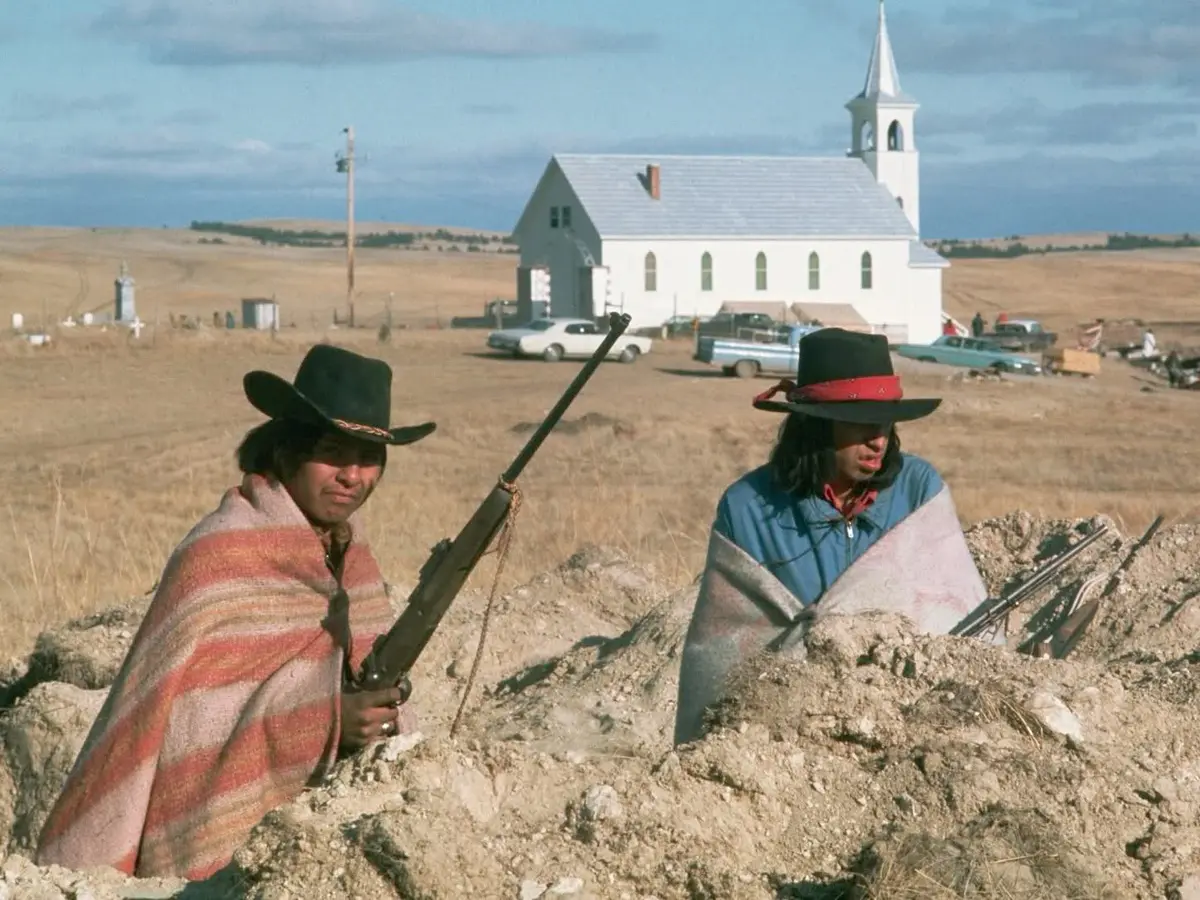


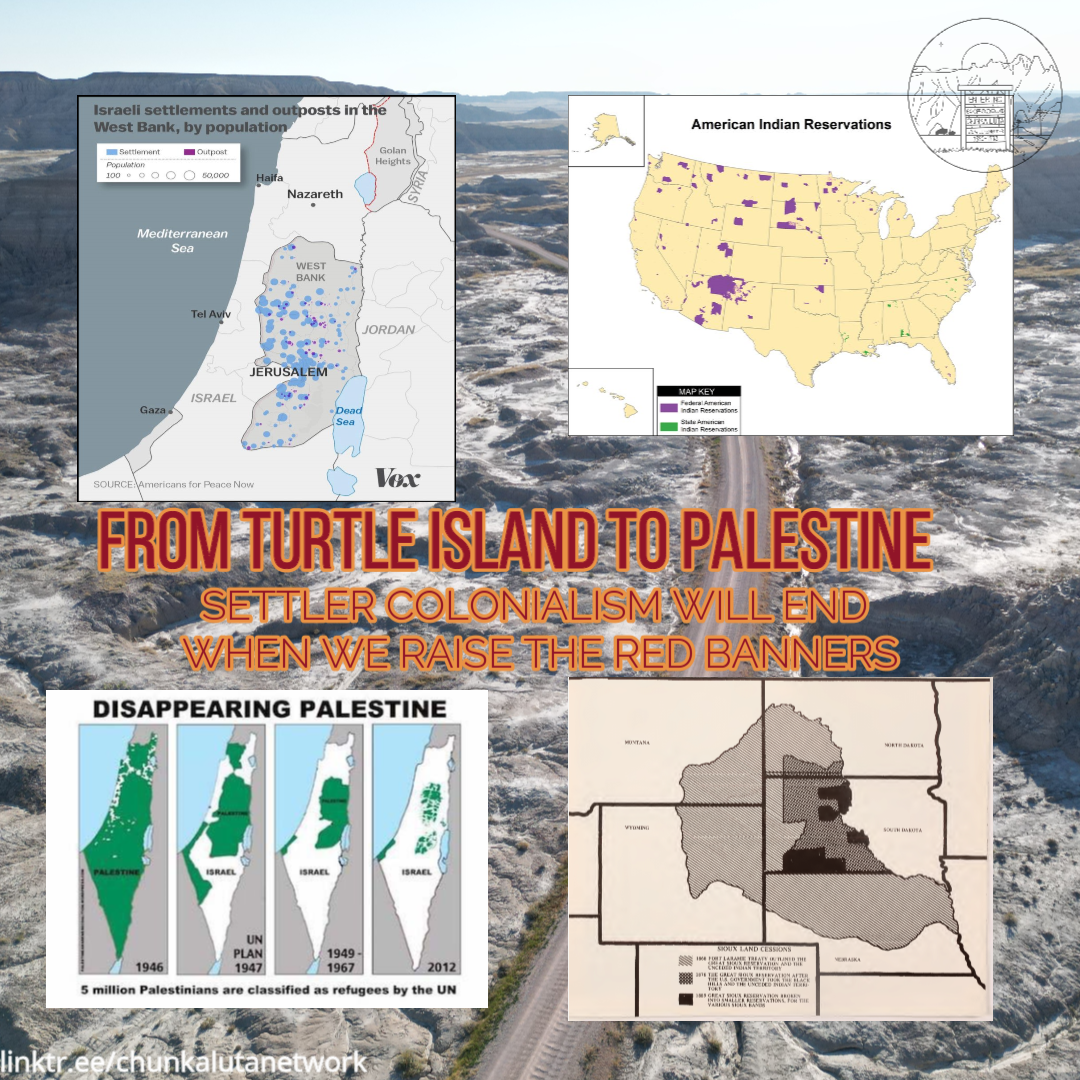
this is exactly how the US got the southwest