
What is dialectical materialism, really?
I’ve seen dialectical materialism used to refer to two different concepts it seems, and I’m unsure about the relationship between the two of them.
In the first camp, I see dialectical materialism used as a static sort of list of qualities that govern all of reality and nature, basically creating a list of universal laws that have predictive and explanatory power in all cases, scenarios and scales, no matter the context. Sometimes people on the internet I see engaging with dialectics in this way are using it in a catechistic sort of way, and sometimes it seems misapplied, like trying to explain black holes using the “three laws of dialectics”.
The other camp seems to view dialectical materialism more as a method of analyzing a system, rather than being a list of rules that describe the behavior of a system, based on internal processes of that system. This seems more similar to what i have read in Capital and how Marx himself tended to engage in dialectics.
What is the origin of this conflict? Is this a real back-and-forth issue between Marxists, or is this some kind of subtext I’m overreading?
The first camp seems to be derived from novices trying to understand and apply it like a formula.
But when you know how it works, really, you don’t need to know to the full rules of the formula as much as how it works practically.
I was gonna go really into detail but I keep getting interrupted so I will do my best with limited words. It starts with the idealist (Hegelian) dialectic which describes the progress of ideas in which a person has a thesis that is challenged by the antithesis, therefore forming a contradiction. This contradiction is eventually resolved resulting in a new thesis called the synthesis. Hegel saw this as the origin of human advancement. The idea creates the material world through this process. Marx adapted this process to a materialist perspective, proposing that the material world created the idea which altered the material world which then altered the idea. This is materialism with a dialectical relationship between the material and the idea in which both affect eachother back and forth while progressing in a single historical direction.
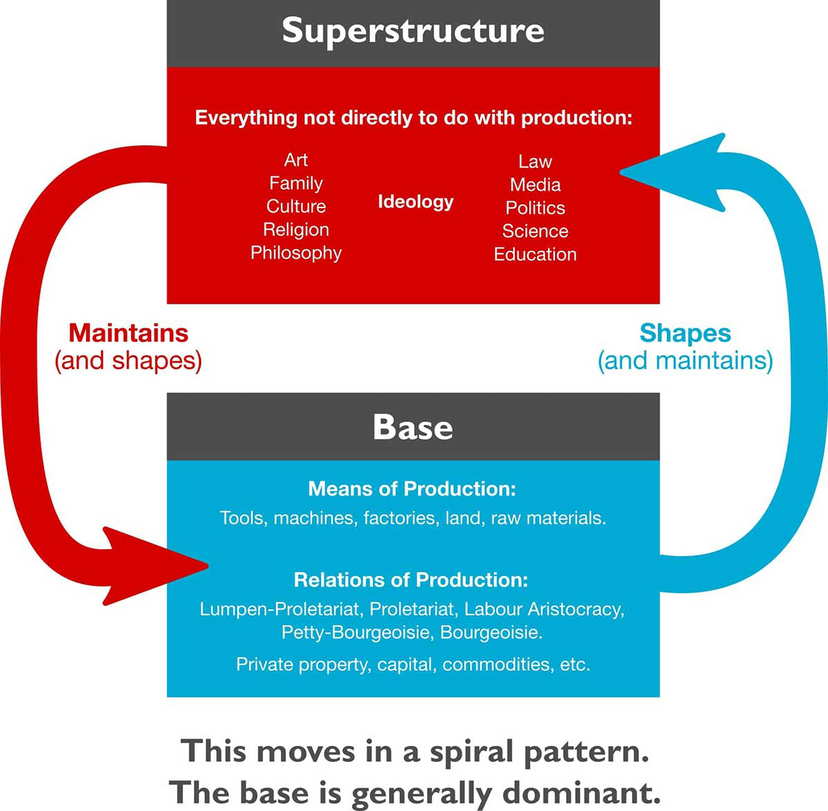
Here is a infographic which should help

This shows how the contradictory material interests between nobles and slaves progressed the means of production to a point where it produced the new economic relation of lords and serfs. This also formed the contradiction between bourgeois and proletariat, all the while being governed by ideologies created by each unique material contradiction. This other infographic is also helpful but I got rate limited so I couldn’t put it in the comment. :(
Dialectical materialism is not a list of rules governing the world; it is a tool that we can use to understand the forces behind the progress of history as it relates to production. Someone proposing the former to you is misinformed or not explaining it well. If anyone notices something I got wrong please point it out, its been a minute since I directly read up on this.
Dialectical materialism is not a list of rules governing the world; it is a tool that we can use to understand the forces behind the progress of history as it relates to production
To comment on this further, it is not a list of rules governing the world but it is describing something universal which exists everywhere and in all things.
All things at all times have internal and external contradictions which are at play. All living things are caught between life and death, all non living things are subject to entropy and are being built up and broken down over time. So while diamat itself isn’t a law of the universe, you can look at the laws of the universe and understand them dialectically.
The laws of the universe are the primary material conditions that all other material conditions are based off of, but studying them and applying diamat to that study isn’t going to change society in the way that changing the economic base is so it isn’t really useful for Marxists or for liberation of oppressed people
I thought the Thesis Antithesis Synthesis thing was Fichtian and a misconception about how Hegelian and Marxist dialectics work
I don’t know its origin but it definitely is the idealist dialectic.
Edit: looked it up and it is Fichtian but Hegel mostly took issue with the terminology not its function. He found it to be a “lifeless schema” imposed upon various contents according to wikipedia. The thesis, antithesis, synthesis model is still useful however. The terms abstract, negative, and concrete used by Hegel suggest a flaw or an incompleteness in any initial thesis. For Hegel, the concrete must always pass through the phase of the negative, that is, mediation. This is the essence of what is popularly called Hegelian dialectics. It is sort of semantic imo.
deleted by creator
Prof Wolff : https://youtube.com/watch?v=bGPSKZgFH70
Both camps are in agreement, in a sense. It’s a method, a form of modelling and understanding reality, that follows its own axioms. Every model will have its own laws, which are taken as a premise (given sufficient evidence of their truth), like gravity. I think what you’re seeing might just be that usual phenomenon of people trying to sound smart by reciting phrases rather than writing actual content.
Like, yeah one could probably talk about black holes in terms of “unity of opposites” with regards to fundamental forces or something like that, but there’s already a lot of physics jargon that is more specific and fitting.
I can highly recommend this article as a comprehensive intro https://dashthered.medium.com/marxism-for-normal-people-dialectical-materialism-deb5034685a4
It’s both, pertaining to the dialectics and the materialism. But it’s not simply mushing the two together to make them into a neat ball. Dialectical materialism compared to its hegelian idealist form has different laws or rules that emerge.
Explaining black holes with dialectics is possible, it’s just we may not be able to explain them yet. I can see a black hole as the negation to… gravity, probably? Light? I’m not sure even the most advanced research on black holes could tell us for sure how exactly it fits within diamat. And things don’t exist in isolation but in relations, which the sum of it forms what we call nature. We are as much part of the natural world as black holes, the planets, the mountains and the animals, and subject to its universal laws all the same.
It can be helpful because darkness is not the negation to light, as negation/contradiction is not the direct opposite/antonym. The contradiction of light/photons is not solved by “the absence of photons” (darkness), it’s solved by its negation - so what negates light/photons? So like I can see people trying to apply dialectics to stuff around them to get a feel for it.
Conversely at times diamat can help us analyze where the material conditions stand, and at times can help us determine a trajectory. Actually it can do both but philosophy is tough lol, it’s tough to go from “I read about this example of dialectics in motion” to “this is my own analysis of the current situation” and this is why there’s so much mistaken dialectics. I probably make a lot of mistakes too.
When Mao analyzed that Japan was an empire on the decline (On Protracted Warfare if I’m not mistaken) he based his analysis on the material conditions in Japan, these conditions themselves subject to dialectics, and from that was able to analyze their trajectory and how he foresaw the war progressing.
Contradictions are the motor of change as they explain not only that change is possible but the mechanism to how it happens. It explains why we don’t live in a metaphysical (static) universe. But as Marx said The tradition of all dead generations weighs like a nightmare on the brains of the living, and this is true of dialectics as well. We inherit the current material conditions (of nature - which includes but is not limited to society) we live under, but also have the power to resolve these contradictions. When applied to social life we call it historical materialism (it’s not just “applying diamat to history”, it refers specifically to social life as per Stalin)
A good diamatical analysis is powerful, but it’s tough to make a good one. It usually comes about after a process of collective struggle, unearthing the dialectic over trial and error and struggling with the material.
I’m not well versed in physics, but in regards to black holes if treated as a system in itself within general relativity their principal contradiction is between gravity and the energy of all it’s particles, including light. Gravity is such a dominant force that nothing escapes the event horizon (no motion), but this contradiction also dictates the motion of objects around the black hole. To be more precise, the phenomenon we call black hole is this contradiction.
The main issue is that black holes can’t be described and predicted in the same way within quantum mechanics (mechanics and dynamics here being key dialectical words), another scientific theory that is fundamentally incompatible with general relativity and is part of the Standard Model of particle physics. There we have another contradiction, now between ideas and the material world, which is what would be solved by a successful development of a Unified Field Theory that can describe both theories in their entirety while also being self-consistent. That is the principal contradiction as present in science itself.
Mechanics (physics) is usually the perfect analogue for dialects, since Marx and Engels very explicitly borrowed words from that field (i.e. “Laws of Motion”).
From your rough description the first camp are stuck in Idealist Dialectics. The qualities described are ideal forms that don’t exist anywhere in material reality. Materialist dialectics only concerns itself with things as they are and have been and takes into account that every change has unseen factors.
In the first camp, I see dialectical materialism used as a static sort of list of qualities that govern all of reality and nature, basically creating a list of universal laws that have predictive and explanatory power in all cases, scenarios and scales, no matter the context.
It seems arbitrary if you don’t know where the list comes from and just memorize it without much thought. I would recommend reading Engels’ Dialectics of Nature as he explains in that book the reasoning behind the list.
I think Bohm actually summarizes the idea the best.
Indeed, to some extent, it has always been both necessary and proper for man, in his thinking, to divide things up, and to separate them, so as to reduce his problems to manageable proportions; for evidently, if in our practical technical work we tried to deal with the whole of reality all at once, we would be swamped…However, when this mode of thought is applied more broadly…then man ceases to regard the resulting divisions as merely useful or convenient and begins to see and experience himself and his world as actually constituted of separately existent fragments…fragmentation is continually being brought about by the almost universal habit of taking the content of our thought for ‘a description of the world as it is’. Or we could say that, in this habit, our thought is regarded as in direct correspondence with objective reality. Since our thought is pervaded with differences and distinctions, it follows that such a habit leads us to look on these as real divisions, so that the world is then seen and experienced as actually broken up into fragments.
— David Bohm, “Wholeness and the Implicate Order”
Diamat sees reality as a single, interconnected whole, where everything flows into everything else. You cannot have a “perfect” definition of an object that perfectly captures it as it exists in the real world, because nothing exists autonomously. The more detailed the definition, the more you’d have to include aspects of things around it, and then things around that, so on and so forth, and so the only way to capture something as it actually exists in the real world would be to capture all of reality simultaneously, which is obviously not practically possible.
Instead, we divide the world up into manageable chunks, into objects and abstract categories, but these objects only reflect the dominant qualities of the system that are relevant to us. They never reflect the full complexities of the system and you will always find things that conflict with the definition you are using upon deeper analysis.
Logically, the reason for this position is because it solves certain logical paradoxes, usually those dealing with identity, such as Ship of Theseus Paradox, Water-H2O paradox, or the teletransportation paradox. Aristotle believed identity was an actual physical thing, that a “tree” isn’t just a label we put on a collection of stuff, but that this collection of stuff actually acquires an additional physical property of “treeness.” Diamat rejects this position and just sees abstract categories like “tree” as a description of the dominant character of a system.
It is kind of like a trend line on a graph. It adds no new information to the pre-existing dataset, it just creates a simple representation of an aspect of the dataset that is of interest.
Engels used the term “metaphysician” in a derogatory way to refer to the kinds of people, like Aristotle, that Bohm talked about in the quote above; people who confuse the the abstract category as equivalent to the physical reality of a thing, as if a “dog” is actually an autonomous object existing out there in the world that perfectly fits the definition of a “dog” and nothing else.
Engels goes into a lot of detail in Dialectics of Nature to show how if you take any abstract object like a “dog” and analyze it very closely, you always find it to be very ambiguous upon further inspections. For example, drawing a hard-and-fast line as to the very precise boundaries of a “dog” in space, or precise boundaries when the “dog” comes into being and passes away, or precise boundaries on the evolutionary tree of what constitutes a “dog” and what does not, you quickly find that these kinds of questions are all pretty ambiguous and you can’t actually draw a hard-and-fast line at all.
This is why in Anti-Durhing Engels says definitions are “useless for science,” because the physical reality of a thing is not to be found in some sort of very precise definition that leaves no ambiguities at all, because such a thing is impossible to construct in the first place. No matter how rigorous your definition is, you will always find internal contradictions if you analyze the object more closely, things that seem to go against the dominant character that you identified.
Hard and fast lines are incompatible with the theory of evolution. Even the borderline between vertebrates and invertebrates is now no longer rigid, just as little is that between fishes and amphibians, while that between birds and reptiles dwindles more and more every day. Between Compsognathus and Archaeopteryx, only a few intermediate links are wanting, and birds’ beaks with teeth crop up in both hemispheres. “Either-or” becomes more and more inadequate.
Among lower animals, the concept of the individual cannot be established at all sharply, not only as to whether a particular animal is an individual or a colony, but also as to where in development one individual ceases and another begins (nurses).
For a stage in the outlook on nature where all differences become merged in intermediate steps, and all opposites pass into one another through intermediate links, the old metaphysical method of thought no longer suffices. Dialectics, which likewise knows no hard and fast lines, no unconditional, universally valid “either-or,” and which bridges the fixed metaphysical differences, besides “either-or,” recognises also, in the right place, “both this-and that” and reconciles the opposites. It is the sole method of thought appropriate in the highest degree to this stage.
Of course, for everyday use, for the small change of science, the metaphysical categories retain their validity.
— Engels, Dialectics of Nature
If we assume that (1) nature is a single unified whole which is impossible to capture in a definition / abstract category, and (2) we still need to use definitions / abstract categories because of our finite mental capacity, then the next question becomes, how do we navigate this? How do we operate with the knowledge that we have to use categories which we know are inherently limited (unlike the metaphysician which fails to recognize the limited nature of these categories and confuses them for reality)?
That is what dialectics is about. It is a logical framework to deal with this.
Engels, in Dialectics of Nature, reduces dialectics to three laws. The first two are the most important as they explain how qualities (abstract categories) are to be dealt with.
The “law of the interpretation of the opposites” is the idea that any concept only makes sense in reference to opposite. The concept of “inside” does not make sense unless it is being implicitly contrasted with “outside.” One of them inherently implies the existence of the other. Logically, the opposite has to exist, and, as said before, upon closer inspection of any object, you will find things which conflict with how you have defined the dominant character. Everything must logically contain these “internal contradictions.”
“The law of the transformation of quantity into quality and vice versa” then explains how these abstract categories change. If I let an apple sit long enough, it will eventually rot so much it ceases be an apple. How does this happen? It’s because there were already non-apple-like things already within the apple that just were not the dominate character, and over time, those grew while the apple-like qualities decayed, until the apple-like qualities ceased to be the dominate character.
The fact that identity contains difference within itself is expressed in every sentence, where the predicate is necessarily different from the subject; the lily is a plant, the rose is red, where, either in the subject or in the predicate, there is something that is not covered by the predicate or the subject. That from the outset identity with itself requires difference from everything else as its complement, is self-evident.
— Engels, Dialectics of Nature
1/2
“The law of the transformation of quantity into quality and vice versa” then explains how these abstract categories change. If I let an apple sit long enough, it will eventually rot so much it ceases be an apple. How does this happen? It’s because there were already non-apple-like things already within the apple that just were not the dominate character, and over time, those grew while the apple-like qualities decayed, until the apple-like qualities ceased to be the dominate character.
The key point of this is that there was never a sudden jump from “apple” to “non-apple.” The properties that causes the apple to become something else was already latent in the apple to begin with, and upon further analysis, you will always find that there is never a sudden “jump” but that every transition between categories is, in physical reality, actually connected through an infinite series of interconnected steps.
“Hard-and-fast lines” that separate things don’t really exist, because again, nature is really a singular interconnected whole, so those hard-and-fast lines always disappear upon deeper analysis. This doesn’t just apply to transitions over time, such as, one object changing into another over time, but also over space, such as, if you place two objects next to each other at the same time, there is no hard-and-fast line you can draw that unambiguously defines where the first object ends and the second object begins.
If one quality is perceived to change to another, it therefore logically necessitates that this change must, upon further analysis, be caused by an infinite series of quantitative interconnected steps connecting the two qualities together. The purpose of this law is to capture the concept of “continual change.”
The third law Engels mentions is negation of the negation, but this one is a lot more complicated and deals with a process of development, and there is debate as to whether or not it even belongs as a foundational logical principle. Mao, for example, did not think so and believed negation of the negation should not be there as a logical principle, and so if you read his On Contradiction, it explains basically everything I have said so far but makes no mention of negation of the negation.
Negation of the negation refers to any sort of system that has an internal cycle such that it always returns back to where it starts, but never exactly to where it started; with slight differences each cycle. If this system can keep a memory, then these differences each cycle can accumulate, causing the system to grow in complexity over time. Systems that develop in nature tend to have this structure.
The core of dialectics, though, is really the rejection of the law of identity; it is the rejection of the view that reality is really made up of the abstract objects we imagine in our heads. The first two laws naturally flow from that singular assumption.
Abstract identity, like all metaphysical categories, suffices for everyday use, where small dimensions or brief periods of time are in question. The limits within which it is usable differ in almost every case and are determined by the nature of the object. For a planetary system, where, in ordinary astronomical calculation, the ellipse can be taken as the basic form for practical purposes without error, these limits are much wider than for an insect that completes its metamorphosis in a few weeks. (Give other examples, e.g., alteration of species, which is reckoned in periods of thousands of years.)
For natural science in its comprehensive role, however, even within each individual branch, abstract identity is totally inadequate. Although it has now been largely abolished in practice, theoretically it still dominates people’s minds. Most natural scientists imagine that identity and difference are irreconcilable opposites, instead of recognizing them as one-sided poles that represent the truth only in their reciprocal action: in the inclusion of difference within identity.
…
Abstract identity (a = a; and negatively, a cannot be simultaneously equal and unequal to a) is likewise inapplicable in organic nature. The plant, the animal, every cell is at every moment of its life identical with itself and yet becoming distinct from itself, by absorption and excretion of substances, by respiration, by cell formation and death of cells, by the process of circulation taking place, in short, by a sum of incessant molecular changes which make up life and the sum-total of whose results is evident to our eyes in the phases of life – embryonic life, youth, sexual maturity, process of reproduction, old age, death.
The further physiology develops, the more important for it become these incessant, infinitely small changes, and hence the more important for it also the consideration of difference within identity, and the old abstract standpoint of formal identity, that an organic being is to be treated as something simply identical with itself, as something constant, becomes out of date. Nevertheless, the mode of thought based thereon, together with its categories, persists.
— Engels, Dialectics of Nature
Dialectical materialism is also not the same as historical materialism. Historical materialism is dialectical materialism applied to analyze the socioeconomic of human societies. Engels once compared historical Marx’s historical materialism to “what Darwin did but for the social sciences.” While Darwin is often associated with “survival of the fittest,” that’s not what Engels was referring to, but instead Engels was referring to the “gradual change” part.
Historical materialism sees human societies as constantly undergoing very gradual and subtle change every time a new piece of technology is developed, a new structure is developed, the infrastructure is expanded, a new institution is built, etc. All of these create very subtle changes to how society organizes productions, and if you accumulate them over thousands of years, then a society can change in such a way that the production process could be unrecognizable to what it was thousands of years before.
2/2
deleted by creator