
- cross-posted to:
- technology@lemmy.ml
- technology
- cross-posted to:
- technology@lemmy.ml
- technology
You must log in or # to comment.
Let me sum this up “China wants to improve mobile internet but at what price”.
lol basically
Thanks for psoting. Really useful article. It shows how craven the US is that they’re barring certain countries from standards bodies for what are supposed to be international standards.
In response, a think tank affiliated with the Chinese Ministry for Industry and IT has argued, China should launch its own international research and development association to win over Europe. Telecoms giant China Mobile appears to think the future is still open. According to a spokesperson, it was still unclear whether there would be a single global standard for 6G and collaborations with Europe, Japan and South Korea continued with “an open attitude.” China’s IMT-2030 (6G) group last year signed an MOU with Europe’s 6G-IA industry alliance.
I really hope that goes well. It would be great if the US gets the could shoulder instead of the Global South.
Europe’s insistence on privacy and empowerment of internet users—as laid out by its Digital Decade Principles - puts it at odds with China and the US.
Classic European arrogance lol. They’re just so civilized 💅🏻
It’s going to be really funny when the rest of the world starts moving past the west using Chinese tech while the west continues to wall itself off and slides into irrelevance technologically.
European century of humiliation, but self inflicted.
Europe’s insistence on privacy and empowerment of internet users—as laid out by its Digital Decade Principles - puts it at odds with China and the US.
China and the EU both have privacy laws protecting internet users. Personal Information Protection Law since 2021 in China. Last I checked it’s the Americans that don’t. But yeah of course Europeans will refuse to acknowledge any common ground and highlight differences instead.
California Consumer Privacy Act is the American GDPR, but it’s just for California.
There is a risk the next mobile internet standard, 6G, won’t be one that spans the world.
Motherfucker I still don’t get 5g in the US! Center of the evil empire adamantly refuses to improve its own infrastructure while whining about China doing exactly that
If we don’t all die of pollution, fire, and/or wet bulb events, the west is just gonna be some wild West cargo cult of scifi, isn’t it? We’re practically there already with how far ahead China is vs our (US) infrastructure. But it feels like just a matter of time before they’re selling us cardboard cutouts of technology marketed as the next best thing.
is there anything an actual human does that wasn’t good enough on 4G?
The spec seems to just be loosely following powers of 2 on transmission speeds.
2G - Kb/s
3G - Mb/s
4G - 100Mb/s
5G - 1Gb/s
6G - 10Gb/s (proposed, 1Km in tests)
What people don’t understand is that all of this is realistically built on massive underground fiber optic networks that have been being built out since ~2006.
China is getting ahead of everyone because their national projects tend to also be infrastructural so they can put hundreds of millions of meters of fiber cables underground during the build out of those new transit lines and residential centers.
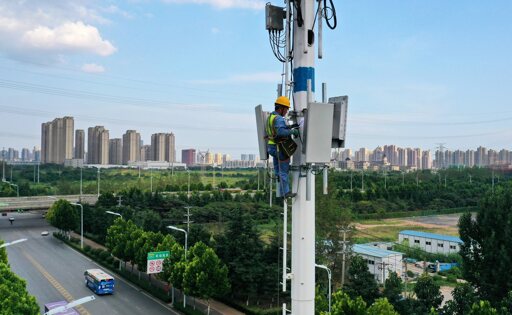
5G and 6G are presented as wireless technology, but they’re more wired than anything else. The high frequencies required for those speeds mean you need antennas/towers like every 500m instead of every mile or 2 for the lower frequency tech (3G and 4G).
Because the only federal and state fiber buildouts in the US are a long major highways, you have a freeway backbone that can support high wireless speed networks, but no one lives on the highway and the short distances mean not even that many people can take advantage of that until FTTH distribution (almost entirely privately owned and state subsidized) is built.
But 6G has AI and it’s essential that everything new has AI to justify how much time and energy everyone spends thinking and talking about AI.
Remote surgery
that sounds like the kind of thing you don’t ever want to be wireless tho
I mean it’s being done in China all the time now.
and i’m sure they’d prefer to run a wire out to whatever remote village if that was feasible
But reality is that it’s not feasible in a lot of places, at least in the near future. Meanwhile, setting up 6G towers is much faster and cheaper in comparison.
deleted by creator
huh i was doing OK with youtube in ~2012 on mobile data but that was relatively static MTGO videos
Even 3.5G was plenty for me. I could get 30Mbps down on that and that was PLENTY for most 1080p YouTube content. LTE at the time was barely any faster, and at some points became slower with congestion.
Network congestion in cities which is kinda what 5G is built for. 4G is still useful for servicing wider areas with less devices
That’s basically why 5G is 3 different things glue together.
There’s low frequency (long range) that’s basically just LTE with some icing.
There’s medium range and quite a bit faster (I can get 1Gbps down in some areas)
And the. There’s mmWave or super short range 5G. That’s designed for concerts and other events with a ton of people crammed into a small area. But even that struggles at time.
Yes, you need much lower latency for robots that interact with the physical world.
most cities in the UK you can barely get mobile data on a halfway busy day, and they’re already talking about 6G? I thought 5G was supposed to be the one that would never need an upgrade because it was so good, anyway?
I thought 5G was supposed to be the one that would never need an upgrade because it was so good, anyway?
they said the same thing about windows 10 smh
another pandemic so soon? 🙄
I don’t even have 5G, I’m already divided.
for people wandering why are they talking about 6G when 5G isn’t even widely available, 3G standardisation started around 2000, 4G started around 2008, and 5G started around 2015. each generation’s standards and documents get finalised in steps and it takes a few years after an standard is released for companies to make products, and it takes time for these to be sold, manufactured and shipped and it’ll take more years to build out the infrastructure necessary to be able to support these products.
the trend for a while has been a new generation every decade, but honestly i don’t see how anything beyond 6G is practical. people just don’t produce and consume that much data even in a complete IoT takeover.