
(This takes nearly four minutes to read.)
While normally I am loath to cite Wikipedia, I make an exception today only because English sources on this event are so shockingly rare that I have no alternative.
Passenger train number 10582, which was part of a [Wehrmacht] transport, left for Vrútky just before midnight on 26 December 1944. The train consisted of 37 wagons which were filled with 375 [Axis] soldiers and officers, as well as ammunition and military equipment. The train crew consisted of two Slovaks, the train driver and his helper.
In the early morning hours of 27 December, the train halted with great difficulty in Kremnica station. The Slovak train driver mentioned to the present [Axis] officers that the brakes didn’t seem fully functional and asked permission to delay the scheduled departure to fix them. The Germans however, refused his offer due to the sensitive nature of the train’s cargo and the possibility of sabotage from partisans.
So the train departed again, and when it tried to brake during the trip to Bartošova Lehôtka station, the brakes failed to respond. The train driver wasn’t able to fix the problem as the train sped at full speed through the station it was supposed to halt at. Knowing that a passenger train was inbound on the same track, the station master who saw the train speed past him, rerouted the train into a dead-end track, hoping the embankment at the end of the tracks could halt the runaway train.[2]
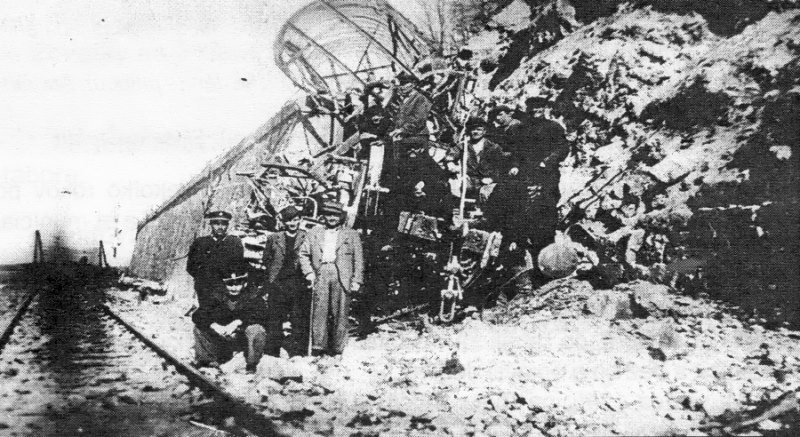
At 9 am, the train reached the end of the tracks at Stará Kremnička and crashed into a reinforced concrete barrier, derailing the locomotive and 17 wagons. The wagons were catapulted over the 8 meter high e[m]bankment and fell back onto the tracks near a tunnel entrance. The boiler of the locomotive was heavily damaged in the crash and ultimately burst into flames. As the flames spread, it ignited the stored ammunitions which exploded and engulfed the train in flames, trapping and burning many men in the wreckage. Out of the 377 people on board the train, only 7 survived with various injuries.[2]
The following is a machine translation of this source:
The greatest tragedy of the German army. A German military transport (37 wagons full of soldiers, ammunition, and military equipment) was dispatched from Vrútky, and its brakes were probably damaged during the journey from Kremnica to Hronská Dúbrava.
At that time, a passenger train was dispatched from Hronská Dúbrava, which was supposed to cross paths with the transport at the Stará Kremnička railway station. At that time, there was already a train (freight) standing in Stará Kremnička, which was heading for Kremnica.
In an effort to prevent a collision between the trains, the stationmaster diverted the German train to a dead-end track, where it crashed at full speed (about 100 km/h) into a freight train. In an effort to prevent a collision, the stationmaster diverted the German train onto a dead-end track, where it crashed into a reinforced concrete barrier at full speed (about 100 km/h).
The train subsequently derailed, caught fire, and ammunition began to explode. Approximately 370 German soldiers were reportedly killed, with only seven reportedly surviving. The Slovak train driver and his assistant were also killed. According to the recollections of local residents, it was hell above the village, with explosions heard and seen for several hours and many shards falling as far as the village.
When searching for which units these could have been, some clues lead to Prievidza. At that time, the headquarters of the SS Dirlewanger unit was located here, which was fighting on the southern border and in the adjacent Hungarian territory at the time, and any movement of supplies or reinforcements… had to go along the Horná Štubňa–Hronská Dúbrava route. But it could also have been any unit from the northern part of Slovakia heading to reinforce the units in the south.
Our civic association is currently trying to obtain any documents about this tragedy, but so far we have only found articles from the press; we have not yet been able to find any official documents from the archives. The railways also have no archival documents from this period. There are no archival documents about this accident in Germany either, which we tried to find out through the German Embassy in Bratislava.
The response also included a note that if this could be officially proven, it would be the greatest railway tragedy of the Germans during World War II. The burial site of these soldiers is also unknown, although some people’s memories mention Kremnica and Trnavá Hora. We have also prepared reports on this topic with TV TA3 and the internet news portal Žiar24.
The Slovak press reports, along with the photographs and the names that they mention, indicate that this event was real — indeed, it would make more sense for the Slovak press to simply not report this event, given the detrimental effects that it would have on the public’s morale.
Given the amount of time that has passed since the incident, we’ll probably never know for sure if it was either purely accidental or the consequence of partisan interference as some have suspected. Whatever the case may be, though, the fact that officials denied a request for maintenance due to a war that did not need to happen raises the question of whether or not it would be reasonable to hold the Axis responsible for this train wreck. I leave that call up to you.
