
- cross-posted to:
- history@hexbear.net
- cross-posted to:
- history@hexbear.net
Highlighting Saxony as one example, this article shows that the brutal mass expulsion of Polish Jews from Germany was not only an unprecedented act of mass violence and viciousness against Jews in Germany, but also became a precursor, a ‘test case,’ for subsequent mass deportations. The Security Service of the Reichsführer-SS and the Main Office of the Security Police most likely did not have fully developed plans for mass deportations ready in October 1938.
However, the [Fascist] authorities could draw on their experiences during the Polenaktion with regard to logistics, coordination of administrative steps and offices, panic control, intimidation, and brutality. These measures set the stage for the arrests and mass transports during the November Pogrom not even two weeks after the Polenaktion and for the mass deportations during World War II.
[…]
The mandatory residency registration with the local police in Germany made it fairly easy for the authorities to produce lists of names and addresses of Polish Jews in a relatively short time.
Although the general course of action was similar in most locations — arresting Polish Jews and handing them the expulsion order — there were considerable local and regional differences in the ways in which the expulsion was executed, which speaks to the lack of centralized organization, personnel, and resources. In some places, such as Wiesbaden, Berlin, and Leipzig, entire families were deported, while in others, such as Hamburg and Cologne, the order applied only to men over the age of 15.
One of the reasons for this difference was the interpretation of the express letter sent by Heydrich’s deputy Werner Best as an addendum to Heydrich’s letter. Although Heydrich’s order was less specific, in his letter, Best referred to ‘the largest possible number of Polish Jews, in particular male adults’ to be forced in group transits across the border to Poland before midnight of 29 October 1938.²⁸
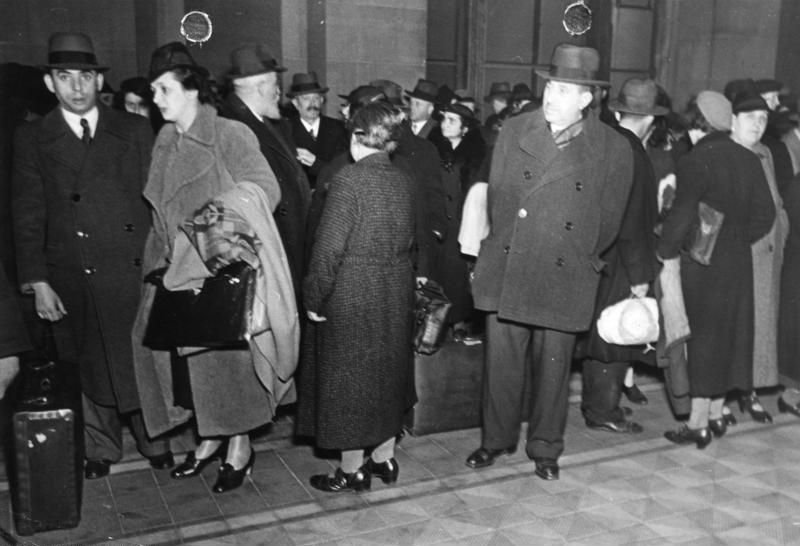
The arrests and group transports began in some parts of Germany on 27 October 1938, while the majority of Polish Jews were arrested between the morning of 28 October and the afternoon of 29 October 1938. The arrests came as a total shock. In general, the deportees were allowed to take 10 Reichsmark and hand luggage with them. The police sealed off their apartments and businesses within hours.
Forced to vacate their apartments immediately (or within 24 hours in some locations), many people were unable to pack necessary items. In several cases, parents were separated from their children, who were picked up from school after the parents had already been arrested. In other cases, families were torn apart due to their different citizenship, residency permits, or emigration papers (or lack thereof), or simply because they happened to be traveling at the time of the roundups.
It is not entirely clear why some police chiefs ordered the arrests immediately after having received Heydrich’s express letter while others waited until the next day.
Arrests of Polish Jews in Saxony: the special rôle of the Polish consul in Leipzig
The documents available prove the decentralized handling of the expulsion orders and disprove Tomaszewski’s assumption that the Aktion started in western Germany because of the longer distance to the German–Polish border.²⁹ In fact, in parts of Saxony, which is closest to the German–Polish border, mass arrests and deportations began on Thursday, 27 October.
The police chief of Dresden reported to the Ministry of the Interior of Saxony that the arrests had been made late in the evening on 27 October: ‘The detainees were gathered in suitable locations and transported the next morning by truck to the Dresden-Neustadt train station.’³⁰
Almost 60 years later, Rolf Neuding, who was 20 years old at the time, remembered that night of terror: ‘At 8 pm we sat down for dinner and heard a knock at the door. There were two policemen in uniform [Schupos]³¹ and [they] wanted to see our passports. We had Polish passports, which they took away from us. They demanded that we come with them. We were totally shocked. We were not allowed to take anything with us. The policemen took us to a big dance hall full of Jews. And then panic set in […] Nobody had any idea what was going on.’³²
Polish Jews in Halle were also rounded up on the evening of 27 October.³³ Word traveled fast to nearby Leipzig. In Leipzig, known for its Yiddishkeit,³⁴ the shock of the impending expulsion of Polish Jews hit particularly hard. With about 9,000 Jews, Leipzig had one of the largest Jewish communities in Germany in 1938.³⁵
Due to the thriving fur business and the city’s international trade fair, which dated back to the Middle Ages, Leipzig had a fairly large Polish Jewish population, too — they made up about one-third of Leipzig’s Jewish population, 3,364 adults and children.³⁶ After Berlin, Leipzig was home to the second-largest Eastern European Jewish population in Germany.³⁷
When warnings about the impending arrests reached Leipzig on the evening of 27 October, some people managed to hide and stay with friends. Others sought shelter at the Polish consulate in the city, which had been opened to Polish Jews by Consul General Feliks Chiczewski in the early morning hours of 28 October.³⁸
As is customary in international diplomacy, Chiczewski considered the consulate, which housed both his office and residence, and the surrounding garden Polish sovereign territory. The Leipzig police, however, disputed that claim, since the Polish government had not actually purchased the villa, but was renting it from the Jewish Ury family.³⁹
The police chief dutifully noted the Polish consul’s ‘erroneous assumption’ that the consulate was ‘extraterritorial grounds,’⁴⁰ but given the fragile state of German–Polish relations, the Leipzig police refrained from entering the premises. However, before allowing some people to enter the Polish consulate, the police checked their identification papers.⁴¹ They arrested others in the street outside the consulate and put them in police cars.⁴²
(Emphasis added.)
You must log in or # to comment.