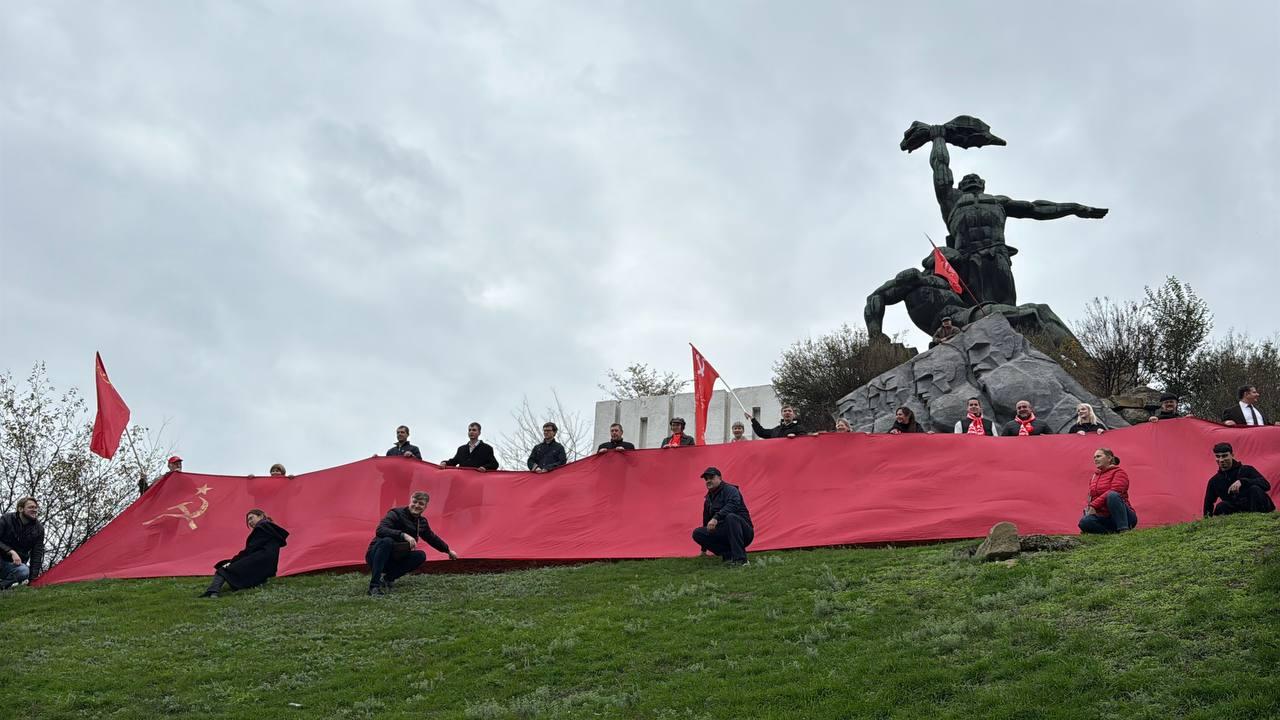

On November 2, 2025, communists and Komsomol members of the Don held a traditional rally in front of the “Continuity of Generations” monument, dedicated to the 123rd anniversary of the Rostov Political Strike of 1902.
If you are interested in the speech, let me know and I will share it.


spoiler
Opening the rally, Secretary of the Rostov-on-Don City Committee of the Communist Party of the Russian Federation D.V. Zhivotov noted:
At the beginning of the 20th century, there were over 30,000 workers in Rostov. Working and living conditions were extremely harsh. They lived on the outskirts of the city, in workers’ settlements. Thousands of people came south from the northern provinces in search of work. Local capitalists took advantage of this. If any worker attempted to protest the inhumane working and living conditions, they were simply thrown out of the factory gates, knowing that the vacant position would be immediately filled by many others willing to work under any conditions.
What prompted the workers to rise up against the tsarist autocracy? Lack of rights and harsh working and living conditions. Workdays reached 14 hours a day, and wages were paltry. Occupational safety and health were nonexistent, leading to frequent casualties. But if a worker injured at work filed a lawsuit against the railway management, the injured party was still held responsible. Medical care was virtually nonexistent: there was only one doctor for the entire Rostov railway hub. Foremen bullied and even beat the workers.
Speaking at the rally, Vladislav Chernogorov and Kirill Shalygin, communists from the Pervomaisky district, spoke in detail about the reasons that prompted the workers to strike and the progress of the strike.
“The strike that began in November 1902 did not occur spontaneously. The Don Committee of the RSDLP carried out extensive revolutionary work among the railway workers. The Don Committee prepared for the citywide strike in Rostov in advance, calling on workers to organize a struggle for their rights. In this work, it relied primarily on the workshop railway workers—the most advanced section of the Rostov proletariat,” began I.N. Nesterenko, Secretary of the Rostov Regional Committee of the Communist Party of the Russian Federation. "The Rostov Strike became a harbinger of the All-Russian October Political Strike of 1905, the 120th anniversary of which we are celebrating today. Russia was entangled in profound contradictions: between developing capitalism and feudal remnants, between landowners and peasants, between workers and a bourgeoisie that used semi-feudal methods of exploitation. All this was exacerbated by national oppression. And, as in the Rostov Strike, in the 1905 Strike the strike movement acquired an all-Russian character when railway workers, the vanguard and most educated detachment of the proletariat, joined in en masse.
“The fact that capitalism hasn’t changed and hasn’t acquired a ‘human face’ confirms the law of the spiral development of society, according to which the next turn of the spiral repeats the trajectory of the previous one, but at a new, higher level. If at the beginning of the 20th century, proletarians huddled in 4 square meters, today’s workers (forced out of rural areas by the lack of work and normal social conditions) live in mortgaged studio apartments, where it’s impossible to even think about expanding a family, and for some, even starting one. The exploitation of labor, while acquiring new forms, remains the cornerstone of capitalism. And we, communists, like our predecessors from the RSDLP, who understood the laws of social development, bear the task of educating society and instilling socialist consciousness in the proletarian masses. Socialism will inevitably triumph,” concluded I. Nesterenko.
A.V. Misan, head of the Communist Party of the Russian Federation (CPRF) faction in the Rostov Regional Assembly and secretary of the Rostov Regional Committee of the CPRF, said that capitalism has “buried” virtually all the gains of socialist society: free healthcare has almost disappeared, fee-based education is expanding, affordable housing is lacking for the majority, and social rights are gradually being curtailed. Rising utility rates have become a real noose around families’ wallets.
Two years have passed since the election of the new Legislative Assembly of the Rostov Region, and only the Communist Party of the Russian Federation faction regularly raises issues of protecting the social and labor rights of residents of the Rostov Region.
Proletarsky District Communist V.V. Kazakov informed those gathered that the “Continuity of Generations” monument had been transferred to the Rostov-on-Don Center for the Preservation, Use, and Popularization of Historical and Cultural Monuments and would soon undergo major renovations.
The rally participants adopted a resolution noting that in the late 19th and early 20th centuries, the development of capitalism in Russia was accompanied by a dual oppression of the Russian proletariat: on the one hand, the continued oppression of the tsarist autocracy; on the other, the merciless exploitation of factory owners.
In the late autumn of 1902, workers at the Main Workshops of the Vladikavkaz Railway, unwilling to tolerate any longer the lack of rights, harsh working and living conditions, 14-hour workdays, abuse, and even beatings from foremen, all while receiving paltry wages, decided to launch a general railway workers’ strike, which lasted 25 days. The strike evolved into a major political uprising by workers throughout Rostov. Up to 30,000 people participated.
V.I. Lenin wrote about the Rostov strike in his work “First Lessons”: “1902: the enormous Rostov strike turns into an outstanding demonstration. For the first time, the proletariat opposes itself, as a class, to all other classes and to the tsarist government.”
The Rostov strike was one of the proletariat’s first steps toward the victory of the socialist revolution, which laid the foundation for the construction of a just society in which honor and respect were determined not by the size of ill-gotten wealth, but by talent, labor, and honest service to the Fatherland. The exploitation of man by capital was abolished.
The Soviet Union has convincingly demonstrated that when the values of democracy and socialism, friendship among peoples and humanism form the foundation of development, its results can delight the entire planet.
The weakening of the working masses, the loss of class vigilance, and the betrayal of the party elite have allowed the country to be plunged back into the abyss of capitalism, which, no matter how much they try to prove to us otherwise, has not changed in its essence.
And now millions of workers, as they say, are experiencing firsthand everything that they only read about in textbooks during Soviet times.
Participants in a rally near the monument commemorating the 1902 strike, symbolically titled “Continuity of Generations,” declared that the workers’ struggle for the triumph of socialist ideals continues. The socioeconomic and sociopolitical crisis into which bourgeois society is increasingly plunging today is a direct consequence of the decay of capitalism in its imperialist phase. Humanity now faces a stark choice: either socialization or the further concentration of capital and fascism.
“Workers of the world, unite!” – this historic slogan of our party remains deeply meaningful today. The solidarity of workers and the friendship of nations, their struggle for a just peace and socialism, is the foundation of victory in the battle against imperialism, reaction, the fascist plague, and the threat of global war!
“We, the participants of the rally, believe that only the implementation of the “Victory Program” prepared by the Communist Party of the Russian Federation will allow the country to emerge from the crisis of capitalism.”
Yes, please do share the speech! This looks like a cool event.
Done! I added the speech as a spoiler at the end of the post because it is long! As a brief teaser:
At the beginning of the 20th century, there were over 30,000 workers in Rostov. Working and living conditions were extremely harsh. They lived on the outskirts of the city, in workers’ settlements. Thousands of people came south from the northern provinces in search of work. Local capitalists took advantage of this. If any worker attempted to protest the inhumane working and living conditions, they were simply thrown out of the factory gates, knowing that the vacant position would be immediately filled by many others willing to work under any conditions.
What prompted the workers to rise up against the tsarist autocracy? Lack of rights and harsh working and living conditions. Workdays reached 14 hours a day, and wages were paltry. Occupational safety and health were nonexistent, leading to frequent casualties. But if a worker injured at work filed a lawsuit against the railway management, the injured party was still held responsible. Medical care was virtually nonexistent: there was only one doctor for the entire Rostov railway hub. Foremen bullied and even beat the workers.
Thanks!
Seconded.