
The socialist mode of production differs from the capitalist mode not only in its form of ownership and the distribution of labor results, but also in its methods for stimulating productivity growth. While in capitalist countries this function is fulfilled by market competition between workers, companies, and states, in socialist countries it is competition. The fundamental difference is that capitalist competition aims to increase production and income by eliminating its opponent, whereas socialist competition is a contest between work collectives, conducted in a comradely atmosphere, aimed at collectively achieving and exceeding planned targets for the benefit of all members of society.
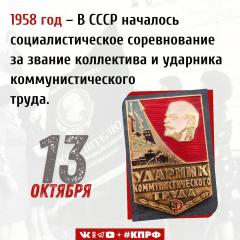
On October 13, 1958, workers at the Moscow-Sortirovochnaya depot took on increased commitments to fulfill the national economic development plan, which included not only improving production technology but also raising the workers’ communist consciousness. This marked the beginning of a competition for the title of collective and shock worker of communist labor. In the following months, thousands of collectives across the country and in fraternal socialist states joined the Moscow railway workers’ initiative. As of January 1, 1972, 42 million people, 106,000 enterprises and organizations, 767,000 workshops, sections, and departments, and nearly 2 million teams across all sectors of the national economy of the USSR and other socialist countries participated in the movement. Over the course of the movement, 19.6 million people were awarded the honorary title of shock worker of communist labor.
Source -> https://kprf.ru/history/date/238090.html