


A team of Shanghai physicians has accomplished a globally rare surgery for an extensive cervical spine dissociation, a condition analogous to head-body separation, the People’s Daily reported on Monday. During the surgery, they successfully pioneered incorporating auxiliary plates beyond conventional fixation to endow the reconstructed cervical spine with unprecedented stability, a breakthrough that marked the first use of such technology for extreme cases.
According to the report, the patient sustained a severe blow to the neck from a robotic arm, causing catastrophic, instantaneous damage to the cervical spine. He suffered high paraplegia and cardiac arrest on the spot, and only barely regained vital signs after emergency cardiopulmonary resuscitation.
Imaging examinations revealed an extremely rare, extensive dislocation of the patient’s cervical spine, with severity comparable to near decapitation. Moreover, the patient teetered on the brink of catastrophic hemorrhage-induced shock or fatal cerebral infarction caused by vertebral artery injury.
“We reviewed numerous domestic and international studies but found no cases of such severe cervical spine separation, let alone any cases where patients survived treatment,” said Chen Huajiang, director of the cervical spine surgery ward at Shanghai Changzheng Hospital.
Chen promptly organized a team with professors from the emergency department, critical care department, and anesthesiology department, and they conducted a meticulous assessment of the patient’s injuries. For every conceivable extreme intraoperative risk - such as uncontrollable massive hemorrhage - the team formulated comprehensive contingency plans and a detailed surgical roadmap.
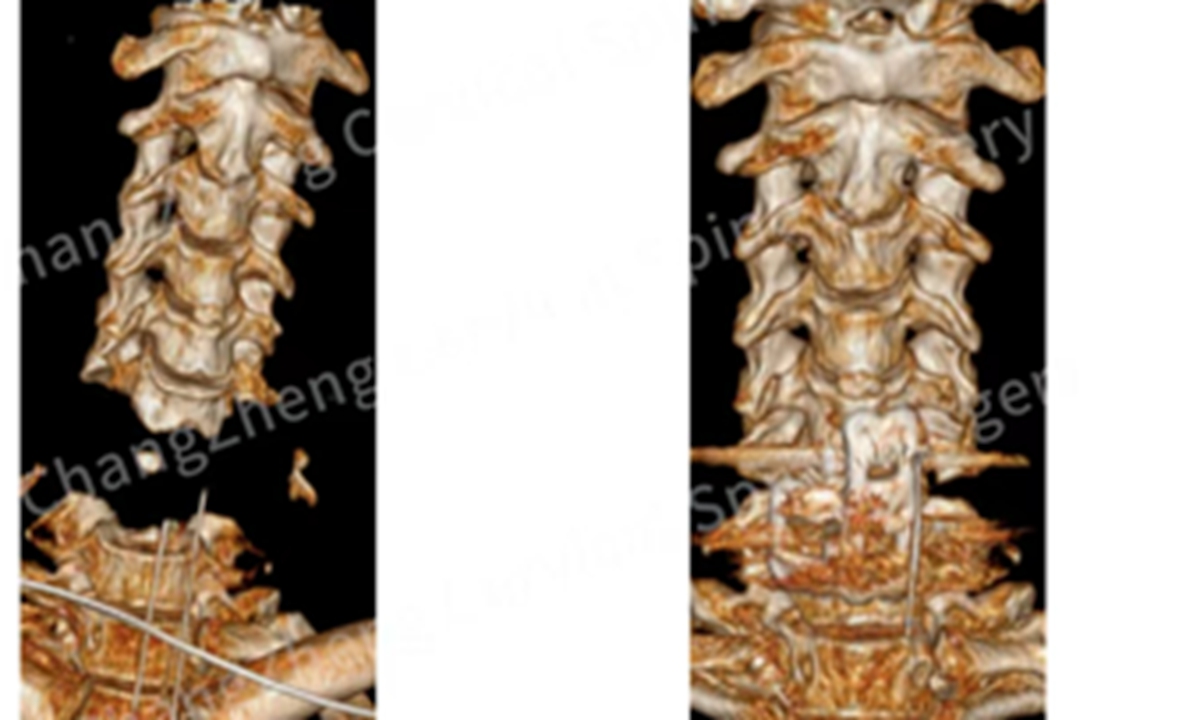
Despite the patient’s critically unstable vital signs, the experts, leveraging exceptional anatomical expertise and microsurgical techniques, evacuated massive hematomas, overcame severe adhesions and deformities, and ultimately achieved precise anatomical reduction of the fully displaced and separated cervical structures.
The team also innovatively added auxiliary plates in addition to conventional fixation to provide stability for the reconstructed cervical spine - an unprecedented application of this technique in such extreme cases.
Chen noted that while the overall plan was clear, intraoperative decisions - such as screw trajectory selection and ensuring secure vertebral fixation - had no precedent for reference, relying entirely on real-time judgment honed through accumulated experience.
When performing complex reduction procedures in such a confined space, “it may seem like we’re just moving bones, but in reality, the surrounding blood vessels and nerves will be stretched. This requires us to be ‘bold yet meticulous’ - avoiding secondary injuries ensuring surgical success,” Chen added.
Fortunately, thanks to the team’s meticulous work, the surgery was successfully completed after approximately three hours. The patient rapidly regained consciousness, with vital signs gradually stabilizing, the report noted.
The patient can now sit up with assistance, marking the emergence of positive signals in his neurological function, and has been transferred to the stage of structured rehabilitation, according to the report.
Comparison of pre- and post-surgery images Photo: Screenshot from the official WeChat account of the Shanghai Changzheng Hospital
Three hours?! That in itself is a feat. I look forward to follow up.
Looks like the person is fully recovering according to another article in China:
Just like this other article mentions:
Very impressive honestly.
It’s extremely impressive. I had to pry my jaw from the floor!
If the patient has the correct mindset (determination), I wholly expect an impressive degree of functionality. What I mean is, “I can and I shall.”
yeah like what the fuck they’re doing some fucked up never before done surgery and they speed ran that shit. I wouldn’t be surprised if similar surgeries in the future couldn’t be done faster even if they knew in advance the steps they needed to take
Chinese AI and robotics continue to amaze!
TBH, in this case it must be fast or the nerves would start outright dying.